Showing posts with label crew boat life. Show all posts

Sunday, December 1, 2013

Seventeen Seagulls

The production boat in our field suffered the third mechanical breakdown in as many weeks Thanksgiving morning.

What that meant for us is that when we headed out on our normal daily run about 0500 Thursday, we didn't hit the dock again until late Saturday.

A good rule of thumb is that mechanical failures, family emergencies, sudden illnesses, falls from ladders and so on that occur on or immediately before holidays are suspect.

I'm not saying the other boat's crew (all of whom are local) went home for the holiday. But I wouldn't be surprised.

So, anyway, we took up the slack. Which was okay, because we had been sitting at the dock for five days, while that other boat rolled around in 10-14 foot seas.

And it's not like we were being fair-weather sailors; every morning the company man at our platform took a look at his weather forecast, took a look over the railing, then called us and told us to sit tight.

By the time we did get to the field, seas had subsided to an easy 2-3 ft. and our nights on the buoy were downright soporific.

Two nights in a row we had a flock of seagulls foraging beneath our deck lights: exactly 17 of them, both nights.

They were quiet, almost ghostly, and soared in and out of the darkness, flopping inexpertly into the water to pick-up their prey. I marked them down as first-winter birds, with blockier heads and less voice than Laughing gulls.

I suspect Bonaparte's gulls, which should be easy enough to identify if I think to look for a couple of distinctive field marks next time.

In other news, our boat has a new first captain, and it's not me. And that's just fine: the guy who was chosen has loads of experience with this company and has been doing this long enough to make his worst mistakes and learn from them.

More than anything I'm happy that we'll now have continuity across watches and someone to make final decisions.
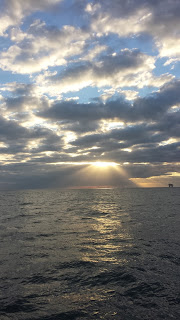
Ever dreamed of working on a democratic boat where decision-making is by consensus? There is a reason that not even the Soviet Union operated a ship as a worker's cooperative.

It. Does. Not. Work.

There are usually about half a dozen ways to do anything out here, and two or three of them probably even work pretty well. Sometimes it just comes down to personal preference or habit, and that's okay.

There's some more shaking-out to do, and we'll see how that goes. I'm sure I don't understand everything -- the resume, the experience, the demonstrated knowledge, the communication skills, the management chops, the boat-handling ability, the maturity, the dues paid, the politics -- that factors into these decisions.

But the fact that the office folks got it right with our lead captain gives me hope, and quiets the turmoil of my thoughts enough that I can go back to counting seagulls.

Friday, November 1, 2013

A Pod of Whales

Our regular run out to the field takes us nearly two hours, the first 45 minutes of which is through the Port of Venice, up and across the Mississippi River and through one of the river's many passes.

Black dots show sperm whale distribution.
When we turn out to the southeast, we show only about 10 feet of water under the keel. That number grows only gradually, until we reach what must be a pretty steep slope in the underlying shelf. The depth goes from about 30 feet to 125 feet in the space of a couple of miles.

The Mississippi Delta is a fascinating place for all sorts of reasons, not the least of which is that -- for reasons I haven't taken the time to discover -- sperm whales sometimes show up there.

Other whales are resident in the Gulf of Mexico as well, including pilot whales, pygmy sperm whales, right whales (a mother and her calf took a little side trip up the Corpus Christi Ship Channel a while ago) and even orcas.

My most common cetacean encounters though are with dolphins -- Atlantic bottlenose dolphins and Atlantic spotted dolphins.

So imagine my excitement early one morning a few weeks ago when a captain on another boat mentioned the pod of whales up ahead of us.

The other boat, a supply vessel, was also making its way out toward our field. In the pre-dawn murk, I called ahead and asked the captain if I could overtake him on "the two," that is, come around his port side.

"No problem, cap," he replied. "Y'all have a good morning."

Then, almost as an afterthought: "Y'all going around that pod of whales up there?"

Pod of whales? What?!

My first thought was: "Why are there whales in such shallow water?"

My second thought was: "How does he know there is a pod of whales up head of us in the dark? Does someone track them and then broadcast their location?"

My third thought was: "Does he have some sort of whale-detecting equipment on his boat? That's weird ..."

I called him back: "Say again?"

"I was just wondering if y'all are going to go around the north end of that pod of whales up ahead," he said. "I usually just go all the way around because they're so close together."

Oh. I see: pod of .... wells.

He was talking about the dense cluster of satellites on our course.

Later the same day, I tell the other captain on our boat the story.

He looked at me strangely: "But I saw a whale today," he said. "It had barnacles all over its back and a big ol' tail, which came all the way out of the water before he went down."

He then proceeded to tell me about other whale sightings.

Should I be so fortunate to see a whale, or even a pod of whales, I'm pretty sure I won't be going around them. I will, though, wake everyone on the boat so they can see them too.

Friday, October 25, 2013

Terror at Tiger Pass!

Somewhere off the coast of Africa this week, an Edison Chouest Offshore supply vessel was attacked by pirates and the American captain and chief engineer were kidnapped.

Elsewhere in the Pacific a couple of weeks ago, some poor ship somewhere was caught in the grip of a typhoon.

I sail on a small ship in a small sea. I suppose I am doomed to diminutive adventures.

I am reminded of the old veteran who was asked which war he served in.

“The Big One,” he replied.

“Oh, wow, I didn’t think you were quite old enough to be in World War II,” the other guy said.

“I wasn’t. I was in Korea, and it felt mighty damned big to me,” retorted the old soldier.

That exchange probably made more sense 20 or 30 years ago when I first heard it – back when Korean War veterans were merely middle-aged. But I digress, before I even get started.

Here’s what happened.

We leave the dock in Venice at 4 a.m. In a driving rain. A left takes us up Tiger Pass, and another left turn to take us north in the Jump to the Mississippi River.

About three-quarters of the way up the Jump, making a little better than 7 knots, I feel the engines suddenly drop out of gear. I pull them back to clutch, and then re-engage the throttles.

According to my gauges, they’re still idling, but there is no response to the controls.

I check my throttle selector -- a tiny toggle switch that moves inputs between the forward and aft helm stations. It’s where it is supposed to be.

Suddenly, my engine monitoring system shows “NO DATA” for two of the engines. The other two flicker in and out.

By this time I have lost all forward momentum and the river’s current is beginning to drag me back. I turn on the Not Under Command lights (red over red), make a security call on VHF 13, and run downstairs to wake everyone up.

Our progress, backwards, to the intersection of the Jump and Tiger Pass
The engineer and the off-watch captain tackle the problem, which we assume to be electrical. The deckhand helps keep lookout, and I man the radios.

There is quite a bit of traffic – supply vessels, crewboats, tugs and barges, shrimp boats --  through the Jump, which portions some amount of the Mississippi River into Tiger Pass and Grand Pass.

The current is not being kind to us, and begins to drag the bow of the boat – the most vulnerable section of the hull – towards a nasty group of pilings on the north bank of the Jump. It occurs to me, belatedly, that I do have control of one engine on the boat, one that is not hooked-up to the malfunctioning monitoring system.

I turn-on the bow thruster and use it to steer the boat. We pirouette gracefully off of the steep bank of a slip, and I flip the boat nearly 180 degrees, hoping to be able to catch an abandoned dock where the Jump meets Tiger Pass.

No one is more surprised than me that I’m able to swing the starboard stern to within a few feet of the dock. 
The deckhand catches a piling and makes us fast, and I use the bow thruster to ease us up against the dock, where we secure the boat.

We are no longer a hazard to navigation.

Meanwhile, the rest of the crew is troubleshooting at a rapid pace. We find a couple of wires melted together in a control box. We isolate and reattach them. We regain throttles for about a minute, before the whole system crashes.

Another crewboat that works our field – and whose captain holds a master of towing vessels – comes alongside to take us back to our dock. Back in the middle of the Jump, we are in the midst of letting go the other boat so he can come around to our starboard side when once again our throttles come to life.

“Let’s see if we can hold ‘em long enough to get back to the dock,” I tell the other captain. “But if you could shadow us back, that would be great.”

And … we make it. Two hours after our departure. We thought we had the problem beat, too, until we tried to leave the dock an hour later and the same thing happened all over again.

Turned out the problem was in the interface between one of the big Caterpillar engines and the aftermarket control system.

Or one of the problems was.

Regardless, it was fixed, and we’re none the worse for the experience.

It was a bit of an adrenaline dump that left me feeling wrung-out the rest of the morning.

And that’s my sea story for this hitch.

Friday, October 18, 2013

Blah, blah, blah

I woke-up yesterday afternoon in time to finish a backload and bring the boat back in.

The shrimping must be really good on the east side of the delta between Main Pass and Baptiste Collette. There sure were a lot of shrimp boats out there.

We took on a little more than 10 tons of fuel and 20 tons of potable water. Changed the oil and filters on the port generator. Just a moment ago I finished tightening-down the stuffing boxes on all four shafts, trying to find that elusive 3-second drip.

At about five minutes after midnight, the engineer offered to head downstairs to wake-up the deckhand. When I finally saw him, at about 00:30, I said: "Look, being late for your watch is a write-up offense. I don't want to write you up. So don't be late."

He looked confused, so I reiterated what I had said the first night we worked together.

"Your watch is midnight 'til noon. I expect to see you 10 or 15 minutes before your watch starts so I can let you know what we have going on, help you prioritize if we have an interruption, or whatever."

He looked more confused, then asked: "But what if I'm not awake 10 minutes before my watch?"

I have a feeling the second half of this hitch is going to be a long couple of weeks.

Thursday, October 17, 2013

Hexadekaphobia

Thursday the 16th. Crew change day. Grocery day. The mechanics are coming on-board to wrap-up the repair on our steering pump day.

Thursday the 16th. The day our customer fires an entire service company and keeps us in the field until every single piece of their equipment, and all their people, are on our boat.

Our platform is ... well, I don't know if it's unique in all the Gulf, but it's certainly different than any I've ever worked before. There are two cranes, which is not unusual. They are pretty short cranes, which also is not unusual.

At both cranes, the crane operator cannot actually see the deck of the boat he is offloading or backloading, which is very unusual. I mean, not at all. Sometimes they'll post a flagger at the rail to relay crane signals. Other times I or the deckhand give the crane operator verbal signals over the radio.

At one point during the backload, the platform sent down a wireline unit that weighed maybe 15,000 pounds. It had three, really long taglines attached to it. For a deckhand with just one free hand who was simultaneously giving signals over the radio to the crane operator and giving me hand signals about where he wanted the boat.

A consequence of this very short crane with no visual communication between the operator and the deck is that he just hangs the load over the water, and I then position the boat under the lift where I want it set down.

Somehow it all worked out.

Well, mostly. For reasons of stability, I prefer to have heavy loads forward on the deck. So I have a hope of seeing the stern of the boat from the aft helm station, I likewise prefer to have tall loads up close to the house.

But I can direct the loading of the boat that way only if I know what's coming. The crane operator, for some reason, has it in his head that I should have heavy lifts on the stern and all the light stuff up front. We went back and forth on this over the radio, and by the time the heavy stuff started coming down, the front of the deck was already filled-up.

Two days in a row we've been back at the dock by 9:30 in the morning. Now, on crew change day, we don't leave the field until midnight.

Because we're heavy, and despite the fact that I've pumped off about 3,000 gallons of water, we'll now only make about 17 knots. In places, only about 15 knots, depending on the water depth.

At the dock, we have a cargo box of supplies and groceries, a couple of crew members signing-on and two very tired mechanics. On board, we have seven unhappy passengers and there is no clear path from the front of the boat to the back of the boat.

I'm no dummy, and I call our dispatcher about two hours out and explain the situation very clearly. I don't demand that he put us under the crane as soon as we get in, but I figure it should be clear that under the crane is where we need to be.

Not only was there a boat already under the crane, our standby spot was two-deep in crewboats.

Turned out there was a hole about 32-feet wide between their sterns and a 65-foot crewboat that spends the night on our dock. It was suggested that I stern-up there to let our passengers off and our mechanics on.

When I got to this boat, I was told that there is not room to top around in this slip (we back down out of Tiger Pass). And in many places -- due to barges, other boats, etc. -- there is not.

But by going to the very back of the slip and topping around in the "T," I was able to slide back to that hole and sort of twist into it using the bow thruster and the inboards.

It felt like a pretty nifty piece of boat handling to me, though I may have been the only one impressed.

Anyhow, all of this led to a delayed crew change, which meant the on-signers hadn't been able to get any rest, which meant that I needed to stay up later (not to mention we were changing the watch schedule), which meant that I had been up, and mostly operating the boat, for 21 hours by the time I was relieved.

Yesterday, of course, we were back at the dock by noon and we're not expected to have another run until Friday.

Apparently that sort of nonsense only happens on crew change day. On the sixteenth.

It's enough to make a fellow develop a phobia.

Wednesday, September 4, 2013

Adventures in Boat Hopping: Prologue

Early last week, early in the afternoon after a long morning watch, and after I had managed maybe an hour of sound sleep, insistent rapping on my door woke me.

It was our training captain: "Gotta get up, man, you're going to the ____." Huh? What?!

Turned out one of the captains on another of the company's boats had a family emergency he needed to get home for, but the boat had just been called for a long run. The plan, approved by the office, was for us to swap boats, with his ride picking him up from my regular boat later in the day.

The other boat pulled into the slip and we laid alongside. I threw my bags over the rail and followed, clambering across the tires.

As I stepped into the house, the other captain rushed down from the wheelhouse, shook my hand, and said: "Let me show you a few things." Steering: switch it here and there. This is where you're going (it's in the GPS). The engineer knows the boat really well -- ask him if you have any questions. "Thanks again!" and he was gone.

Only then did it dawn on my sleep-befuddled brain that not only was I filling-in for a captain on the boat, I was filling-in for the captain presently on watch. The 100-mile run? That was going to be all mine.

The 24-hour watch. Awesome.

As it happens, it turned-out to be a pretty nice week. 

This other boat is the largest in our fleet -- on of two 172-footers -- and has been retrofitted with a Kongsberg Dynamic Positioning system. I didn't turn it on.

Staterooms are large (desks, even!) and mattresses relatively new and comfortable. More importantly, perhaps, the galley was well-stocked with Dr Pepper and the crew was both pleasant and helpful. Not to mention entertaining.

Not that the week was incident-free: we had a generator go tits-up halfway through a run and another evening had a scare with the air conditioning. 

The other watch lost our gangway right before a run, but the engineer and I went fishing when we got back and were able to recover it.

Like I said, a pretty good week. It's always interesting to learn a different boat and a different job and to meet new people. Here's hoping all my relief captain hitches go as smoothly.

Friday, August 23, 2013

This and That

Back on the boat and we've been running hard the past few days.

This is my last two weeks as permanent crew on this boat, and it is a bittersweet feeling. 

Most of us out here, I think, like the feeling of having a permanent "home" at work. In an unpredictable business, it's nice (usually) to work with a crew you know on a boat you know on a job that is familiar.

I give a lot of credit to my company that I was able to have an extended conversation with the HR manager and VP about options that would give me a little more time at home with the family. From what I read and hear from other mariners, even broaching such a subject at a lot of companies is likely to land you on the dock immediately.

We weren't able to work-out a formal solution, but in a couple of weeks I'll become a relief captain here, a floater ... kind of like a turd in the giant toilet bowl of the Gulf.

The impetus for the change is this: I have a high school freshman and two toddlers at home. My amazing wife, who works about 60 hours a week, struggles to keep up with the little guys, the house and her job while still getting at least five hours of sleep a night.

The 3-year-old struggles with some other things because his dad is gone. The 1-year-old changes almost daily. And the 14-year-old, well, we have some things to work on.

And I miss all of them, terribly, when I'm gone a month at a time. But if it was just me missing them, I'd take the lump, because after all I did choose this work. And I love my job.

At this point, though, it's a matter of one kid's healthy development and my wife's mental and physical survival.

So, now, in a best-case scenario, I'll essentially work 14/14 with no guarantee of the 14 days on. It was like flicking a switch: I went from worrying about the family in my absence to worrying that I won't be making enough money.

But I'm grateful that my company will continue to carry me on payroll and give me an opportunity to work. And they say I'm welcome to come back full-time whenever I like.

Most guys I talk to - and I've actually conducted a poll on this topic - are very happy with their even-time schedules. 

Of course, all of the guys who have that schedule are on bigger boats at bigger companies and making 50-100 percent more per day than I am, which adds up to a pretty good living for 180 days a year.

That's my goal, too, actually, but it's still a year or two down the road, what with sea time and classes and testing.

In other news ...

On the professional mariner forums there is sometimes some back-and-forth about who are the better, or more professional mariners: the blue water shipping guys or the oilfield boat handlers or the towing gurus, the 1600-ton masters and mates or the 100-ton schmucks like me who have to live-boat everything.

As a broad generalization, I'll say that typically the folks with larger tonnage licenses seem to be a bit more on the ball. But I'm here to tell you there's good and bad everywhere.

Chalk some of that up to "we're all human," and "everyone makes mistakes sometimes." But it's also true that there are idiots everywhere......

Yesterday morning in the wee hours I found myself southbound for sea behind a supply boat with all of its deck lights blazing. Imagine driving down the highway with an oncoming vehicle in your lane with the high-beams on. It was sort of like that.

After several attempts (another boat chimed-in: "That's the Seacor Deaf-and-Dumb, Cap. Good luck.") I finally got the other boat on the radio and kindly asked the captain if she needed those lights or might she turn 'em off.

"I'm sorry," she said. "I didn't even realize they were on."

She then proceeded to have a detailed conversation with someone on another boat about (her husbands? brother's? friend's?) appendicitis. On VHF Ch. 13. Which, in Port Fourchon, is not the channel to conduct friendly conversations, or even to think out-loud. 

It's busy, busy, busy here, and boats need to be able to broadcast security calls and make passing arrangements. Right now.

A little later, I noticed an odd set of lights just off the Martin fuel dock, and just ahead of a northbound crewboat. It was a kayaker, paddling up the bayou in the dark. He got bonus points for exhibiting the required all-around white light. He lost all of those points for also exhibiting a bright red light. 

He plunged into a lifetime points hole for crossing the channel ahead of a work boat and for not having a radio tuned to 13.

Or maybe he did have a radio, but just wasn't talking into it. In which case he would have heard himself referred to as a "retard," an "idiot," an "organ donor," and worse.

Compare and contrast with the captain of the pogey boat Vasco de Gama, who called me as I was approaching the end of the Belle Pass jetties, just to let me know he was holding-up before he crossed the channel.

Which he should have, but it's always nice to know that the other guy knows what he's supposed to do.

In the Northeastern Gulf right now, there's a low-pressure trough moving steadily westward over us. 

The National Hurricane Center says there's only a slight (10 percent) chance it will develop into a tropical cyclone, but we should expect thunderstorms, lightning, strong wind gusts and occasional heavy rain over the next four or five days.

We've had a wicked pretty moon over the horizon in the west in the mornings this week, and from the wheelhouse I can see "isolated showers" here and there across the Gulf. It's a pretty nice view.

One of my cousins asked an interesting question on Facebook the other day: "What's it smell like out there?"

It smells like the sea, but not like the beach, where there is more (often decaying) organic matter. It's a clean, briny sort of aroma, most of the time. Sometimes you get the sweet, mulchy odor of feeding or schooling fish. In the vicinity of those thunderstorms you can often smell ozone.

Less often you might get a whiff of diesel exhaust from the boat, or grease or oil or driling fluids near a rig.

But usually the wind is blowing over open water and it's pretty nice.

Tuesday, July 30, 2013

May I?

Complain, I mean? Just this one time. For a little while?

I'll be okay later in the week, as the hitch draws to a close. But right now I'm in the past-the-midway-point-but-not-nearly-home part of this thing and I'm tired.

Tired of the noise. Our generators, the satellite TV (almost never off), the radio traffic, the engines of other boats reverberating through our aluminum hull, the rumble and whine of cranes on the dock, the clomp of boots on the stairs .... I crave quiet, right about now.

Tired of my deckhand. He generally does a good job, but he is s-l-o-w. For instance, it's now after 4 a.m., and he still hasn't finished his weeklies.

We're not jerks about this stuff, on this boat. The entire list of deckhand duties -- dailies and weeklies -- fits nicely on one sheet of paper. We thought carefully about what was reasonable and necessary when we put it together. We solicited input from the crew members who would actually be doing the work.

Part of the understanding is, I thought, that the deckhand would knock-out those fairly light duties at the beginning of the watch. Because you never know what might happen later; like, rain. Or a run to our drilling rig. Or ... whatever.

As a matter of fact, I hear snores from the lounge. ... Really? Nah-uh. No way. Hold on. I'll be right back.

Okay, I'm back.

I'm tired of that horrible, helpless feeling when I realize, again, that the 3-year-old's awful meltdown this morning is because he doesn't want to go to pre-school because he's afraid his mother won't be there in the evening, because really deep-down he's freaked-out that Daddy isn't home.

I struggle, all over again, with whether being out here is the right thing for me -- for my family. I love my job. I really do. I'm pretty good at it, too, and I actually can't think of anything else I want to do or even that I *could* do that would pay anything close to what this does.

But I also love my family and I love spending time with them and being a part of their lives on a daily basis.

It's a conundrum, I tell you.

Or ... maybe not, really.

Sunday, July 28, 2013

Sturm und Drang

Well, today, anyhow. Lightning. Sheeting rain. More than 11 hours underway.

We headed out this morning with a larger-than-usual deck load and 15 passengers.

At the rig, the wind was out of the west-southwest, the current still pulling toward the east-southeast. Into the platform.

The rig called one of their supply boats over and thus began a complicated (but mostly time-consuming) cargo shuffle. Stuff from our deck to the rig floor. Stuff from our deck to the other boat's deck. Stuff from their deck to our deck. Stuff from the rig to our deck.

The supply vessel has dynamic positioning. We don't. But in the back-and-forth banter between the crane operator, the other boat and us I caught a fleeting, off-hand compliment from the crane operator: "Well, at least this guy can hold the boat in there. That makes a huge difference, believe me!"

I was being compared to the captain of the boat we replaced on this job. Then came a critical recollection of another captain who couldn't: "Had to chase him all over the Gulf with this crane ...."

Unfortunately, that guy was formerly on one of our other boats. He's "no longer with us," as they say.

Still, positive reinforcement is rare out here and I'll take what I can get.

Between cargo transfers, our engineer got some time on the sticks; he's off to school at the end of this hitch and hopes to come back as a training captain.

After nine years on deck and in the engine room, it's about time, and I look forward to working with him in the wheelhouse.

Almost three weeks down and just a little more than one to go. I don't really start counting the days until the weekend before crew change -- it's easier if I just don't think about it until I can count the wake-ups on one hand.

And not just because I'm bad at math.

Monday, May 13, 2013

Rolling, rolling, rolling ....


Coming into day seven of long, back-to-back runs. We’ve done a bit of everything: we have been to drilling rigs, lift boats and production platforms; pumped water and fuel, transferred cargo and personnel, even got a few hours of standby time in 200-feet of water.

During our offshore standby time the lead captain caught a tuna on the first drop, and that was lunch.

The weather has been all over the place, too, with a late-season cold front stalled over the area. Two nights in a row we had 40-knot winds, 5-to-7-foot seas, lightning and torrential rain. We even had hail, which makes quite a racket on an aluminum-hulled boat.

I’m also coming into day 27 of a 28-day hitch. I figured-out a while back that it’s not helpful to count the days ‘til the end, which now is nigh. Phew!

I could complain about my first hitch on this boat, but I’d have to make something up. The crew is still coming together, but the new first captain seems like a real good guy.

Back when we were still sitting at the dock a couple of days at a stretch, back in the good old days, we got some painting done on deck and have been tackling small repair and maintenance projects as we can. But mostly things are in good shape, and what’s not will be fixed when we go to shipyard in a month or so.

In the last week of running, I have been reminded of some of the unique privileges of this work. A new moon and a cloudless sky several nights have showcased the spangled vault above with the great, hazy wash of the Milky Way arcing overhead.

Our bow wave this past week has been a molten cascade of blue. It is the electric blue of lightning, the neon blue of sin, the plasma blue of a Star Trek warp drive.

On no more evidence than the color, I blame moderate densities of Noctiluca scintillans. The water is still cool enough for those bioluminescing dinoflagellates to be hanging around.

Anyhow, mesmerizing to watch, difficult to photograph.